Red Flags & Boundaries
There’s usually a quiet moment. Maybe late at night, after another argument, or during one of those silent car rides, when your gut whispers what your heart doesn’t want to admit:
“Something’s not right.”
You try to shake it off. You tell yourself you’re overthinking. You remind yourself that every couple struggles. And it’s true, every relationship goes through hard seasons.
But there’s a difference between normal ups and downs and repeated patterns that leave you feeling unsafe, unseen, or completely disconnected.
That’s when what you’re noticing isn’t just “a rough patch.”
It’s a red flag.
So...What Do Red Flags Actually Look Like?
Sometimes they’re loud, things like repeated lies, emotional manipulation, or betrayal.
But often, they’re quiet and steady, showing up in the everyday:
Feeling like you have to walk on eggshells to keep the peace.
Constantly apologizing just to end another fight.
Being blamed for every issue while your partner avoids accountability.
Hearing promises to change… without ever seeing real follow-through.
The most painful part is how easily you start to question yourself.
“Am I being too sensitive?”
“Maybe I’m expecting too much.”
“Is this just what marriage looks like now?”
And maybe, yes, you are feeling sensitive right now. But that doesn’t make you wrong. Sensitivity is often your soul’s way of signaling that something needs care or clarity.
Instead of dismissing what you feel, try setting a gentle boundary next time say something like,
“When that happens, it really affects me. Can we talk about it differently next time?”
A soft boundary like that helps you see the truth more clearly. It reveals whether your feelings are being met with understanding or defensiveness, and that tells you a lot.
Friend, that’s how you begin to discern what’s healthy. Red flags blur your sense of what’s normal until you can’t tell if you’re standing on solid ground. Boundaries help you find your footing again.
Red Flags Don’t Go Away on Their Own
Pretending not to see them doesn’t make them disappear.
Minimizing them doesn’t make you “strong.”
And speaking up about them doesn’t make you “difficult.”
It means you’re finally showing up for yourself.
When you name the truth, even when it hurts, you reclaim your clarity.
And clarity is what leads to strength: the strength to draw boundaries, make changes, and protect the space where you can finally breathe again.
Boundaries: The First Step Back Toward Safety
Boundaries aren’t about punishment or control. They’re about safety, emotional, spiritual, and relational.
They don’t end relationships; they start the journey of healing them.
When you say,
“I can’t keep doing this,”
or
“Something has to change for us to move forward,”
You’re not rejecting the person, you’re inviting growth. You’re saying, “I want this to work, but not like this.”When you say, “I can’t keep doing this,”
HOWEVER...seeing as boundaries, when implemented correctly, are all about healing and rebuilding, instead of just saying "I can't keep doing this," you can follow it with:
“I can’t keep doing this the way we’re doing it because I want us to be closer, and this feels like it’s pushing us apart.”
That small shift changes everything. You’re not rejecting your partner, you're showing them you want deeper connection.
You’re saying, “I care about us too much to keep repeating what’s breaking us.”
Boundaries don’t have to sound harsh or accusatory. They can be full of truth and tenderness. When expressed with calm and love, they become an invitation — not a wall.
Remember, boundaries are living things.
They should move, stretch, and evolve as healing begins. If you never let them shift, you stay stuck behind them. But if you never set them, you’ll stay stuck in pain.
📖 “Let your ‘Yes’ be yes and your ‘No,’ no.” – Matthew 5:37
Ask Yourself — Is There Anything I Can Do to Feel Safe?
This simple question changes everything.
Safety isn’t only about what someone else does; it’s also about how you care for yourself while God works on what you can’t control.
Ask yourself:
What helps me feel calm and grounded when I’m triggered?
Who can I reach out to for prayer or support?
What boundaries or routines remind me that I’m worthy of peace?
Sometimes, safety means stepping away for a while. Other times, it means speaking truth in love or asking for help.
Each small step toward peace is a step toward growth.
📖 “The Lord will fight for you; you need only to be still.” – Exodus 14:14
You Deserve More Than Survival
You were never meant to live in constant anxiety or uncertainty.
You were created for love that’s steady, not conditional.
You deserve to be heard.
You deserve to stop begging for the bare minimum.
And you deserve to feel safe in your own home and heart.
So if your relationship is filled with red flags and excuses — maybe it’s time to stop hoping it’ll just get better, and start doing something different.
Where to Begin
Name the red flag. Don’t minimize it. Write it down. Call it what it is.
Set one small boundary. Protect your peace, even if it’s just for a moment.
Find support. Whether that’s our Marriage Support Group, a mentor, or a counselor, don’t try to heal in isolation.
Start healing, even if your partner isn’t ready yet.
You’re not weak for needing safety.
You’re wise for recognizing what’s breaking your peace.
Ready to Take the Next Step?
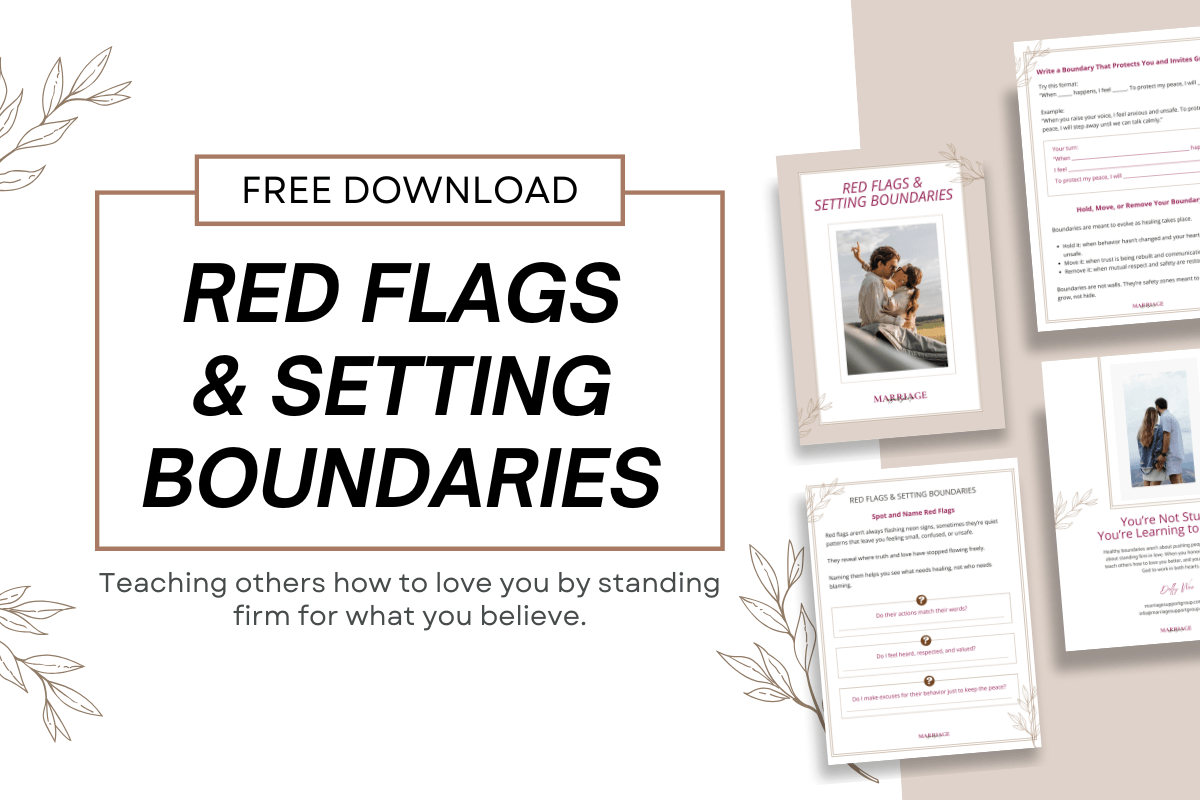
We created the Red Flag & Boundary Reset Guide to walk you through:
How to identify and name red flags
What boundaries really are (and aren’t)
How to write one that protects you and invites growth
Boundaries are not walls. They’re safety zones meant to help you grow, not hide.
Get weekly Date Night Ideas.
Sign up for our weekly Newsletter...
Resources

It's hard to move forward when you're consumed by the pain!

7 Phases of betrayal every couple must go through.

Built on 9 years of proven steps to transform communication and reconnect couples.
About me

Hi, My name is Dolly, and I've been a marriage coach for over 9 years after rebuilding my own marriage and realizing how hard it is to find answers, actions steps, and support! For those ready to make a change, join us!